Key Engineering Principles Behind 24V Smart HVAC Control
Despite rapid advances in inverter-driven HVAC systems and smart building automation, the 24VAC control architecture remains the dominant standard across North America and many Middle Eastern (GCC) markets.
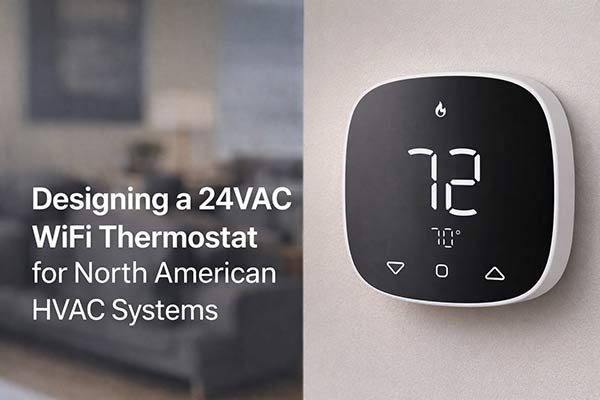
For HVAC manufacturers, distributors, and system integrators, developing or sourcing a reliable 24VAC WiFi thermostat requires far more than adding wireless connectivity to a traditional control board. It demands careful consideration of electrical stability, multi-stage logic, dual-fuel switching, firmware architecture, and regional deployment conditions.
This article explores the engineering principles behind a scalable 24VAC WiFi thermostat platform designed for modern residential and light commercial HVAC systems.
1. Why 24VAC Remains the Industry Standard
The 24VAC control system became dominant because of its:
Electrical safety (low-voltage control loop)
Transformer isolation
Compatibility with relays and contactors
Standardized terminal labeling (R, C, Y, W, G, O/B)
In North America, most forced-air furnaces, heat pumps, and air conditioning systems still rely on this architecture. Similarly, in GCC markets, centralized air handling units and ducted split systems commonly use 24VAC-based control interfaces.
For manufacturers, this legacy compatibility ensures that a properly designed thermostat can support:
Conventional systems (up to 2H/2C)
Heat pump systems (up to 4H/2C)
Emergency heat
Dual fuel configurations
Humidification and dehumidification modules
2. Rc/Rh Separation and Transformer Isolation
One overlooked engineering challenge in thermostat design is Rc and Rh separation.
Some HVAC systems use:
A single transformer (jumpered Rc/Rh)
Separate heating and cooling transformers
A robust thermostat platform must:
Detect dual-transformer configurations
Maintain proper isolation
Prevent back-feeding between circuits
Improper isolation design can lead to transformer damage or erratic compressor activation.
In large villa installations common in the Middle East, multi-transformer configurations are more frequent, increasing the importance of stable power handling architecture.
3. C-Wire Power Stability and WiFi Reliability
Adding WiFi functionality introduces a significant engineering requirement: stable power supply.
Unlike legacy mechanical thermostats, WiFi thermostats require:
Continuous power
Stable voltage regulation
Surge tolerance
RF noise suppression
In hot climates such as Saudi Arabia or the UAE, high ambient temperatures can:
Increase transformer load
Reduce power supply efficiency
Stress onboard voltage regulators
Therefore, a properly engineered 24VAC WiFi thermostat must include:
Efficient AC-DC conversion
Thermal management design
Brownout protection
Power conditioning circuitry
These are critical factors in long-term deployment stability.
4. Multi-Stage Heat Pump Logic (Up to 4H/2C)
Modern North American HVAC systems frequently include:
2-stage compressors
2-stage auxiliary heat
Variable-speed air handlers
A scalable thermostat platform must implement:
Intelligent stage timing
Adjustable temperature swing
Short-cycle protection
Compressor delay logic
Emergency heat override
For heat pump systems, O/B reversing valve logic must also be configurable to support manufacturer-specific behavior.
From an OEM perspective, firmware flexibility is just as important as hardware compatibility.
5. Dual Fuel Switching Algorithms
Hybrid heating systems (gas furnace + heat pump) are increasingly common.
Effective dual fuel control requires:
Outdoor temperature acquisition
Switching thresholds
Lockout control
Cost-optimization logic
Outdoor temperature data can be obtained via:
Wireless outdoor sensors
Online weather APIs
BMS integration
For OEM platforms, firmware must support customizable switching logic to match equipment manufacturer requirements.
6. API Architecture and Integration Capability
For distributors and system integrators, hardware compatibility is only part of the equation.
A competitive platform must offer:
Device-level APIs (MQTT, HTTP, Modbus TCP)
Cloud-level API access
Local integration modes
OTA firmware upgrade capability
In commercial or multi-property deployments, remote diagnostics and firmware updates significantly reduce field service costs.
This is particularly relevant in GCC markets where properties may be geographically distributed.
7. Accessory and IAQ Expansion
Advanced 24VAC thermostats should support:
1-wire or 2-wire humidifier control
Dehumidifier activation
Ventilation logic
Fan delay customization
Air quality monitoring inputs
Indoor air quality management is becoming more relevant in both North American and Middle Eastern markets due to energy efficiency regulations and occupant comfort expectations.
8. Regulatory and Market Compliance
For cross-regional deployment, compliance is mandatory:
FCC (United States)
IC (Canada)
CE (where applicable for exports)
Local telecom approvals in GCC countries
Certification planning should be considered early in the OEM design stage to avoid market entry delays.
9. Long-Term Platform Scalability
From an OEM and ODM standpoint, the most important factor is platform scalability.
A well-designed 24VAC WiFi thermostat should support:
Firmware customization
UI branding flexibility
Multi-language support
Sensor expansion
BMS integration
Private cloud or third-party cloud connection
This ensures the product can evolve alongside HVAC and IoT market demands.
For manufacturers and integrators operating in North America and GCC regions, selecting a scalable 24VAC WiFi thermostat platform is not simply a hardware decision — it is a long-term architectural choice.
Final Perspective
While HVAC technology continues to advance, 24VAC control architecture remains the most practical and widely deployed interface for residential and light commercial climate systems.
Designing a high-performance 24VAC WiFi thermostat requires careful engineering across electrical stability, multi-stage logic, power management, firmware architecture, and integration capabilities.
For companies targeting North American and Middle Eastern HVAC markets, engineering depth — not just connectivity — defines long-term product success.